
 BESTPRICY
Buyer confidence comparison
A convenient chewable adjunct with a more detailed seller-described ingredient list, but insufficient product-specific evidence and incomplete label details prevent a strong efficacy or value conclusion.
Bestpricy buyer confidence comparison
| Criterion | DentaBiome | ProDentim |
|---|---|---|
| Product Info | 8.6 | 8.6 |
| Evidence | 7.8 | 7.8 |
| Offer Value | 8.0 | 7.8 |
| Seller | 8.3 | 8.0 |
| Guarantee | 8.6 | 8.6 |
| Overall | 8.3 | 8.2 |
How we calculated buyer confidence
This visual measures how much decision-useful buying information is documented, not whether a product is clinically effective. Every scored product passed a minimum publication gate with an authorised destination and saved research dossier, represented by a 7.2 baseline. Up to 2.8 additional points reflect Product Details, Evidence Clarity, Offer Value, Seller Clarity and Guarantee Terms. A higher score is not a medical rating or a promise of results.
DentaBiome: 8.3/10
Review basis: Evaluation of the supplied DentaBiome sales-page claims, listed composition and usage, documented commercial terms, general oral-probiotic reviews, and dental guidance; no hands-on testing or laboratory analysis was performed.
- Product Details — 8.6/10
- The seller names several strain categories and other ingredients and gives a once-daily chewable format, but key ingredient amounts, bottle count, and tablet count are not clearly documented.
- Evidence Clarity — 7.8/10
- General oral-probiotic reviews report mixed, strain-specific evidence, and no independent clinical evidence specifically testing the finished DentaBiome product is identified.
- Offer Value — 8.0/10
- The chewable format may be convenient, but the final USD price is not reliably exposed and product-specific usefulness cannot be weighed confidently against established dental care or alternatives.
- Seller Clarity — 8.3/10
- The official sales page states a product identity, usage directions, ingredient categories, and manufacturing assurances, but the complete standardized label and several material disclosures are unclear.
- Guarantee Terms — 8.6/10
- A 60-day money-back guarantee is advertised, but the exact return procedure and whether opened or empty bottles qualify are not clearly explained.
ProDentim: 8.2/10
Review basis: Evaluation of the supplied ProDentim sales presentation, listed composition and usage, commercial terms, cited strain research, FDA information, and general oral-probiotic evidence; no hands-on testing or laboratory analysis was performed.
- Product Details — 8.6/10
- The seller names three probiotic strains, states 3.5 billion total organisms, and lists additional ingredients, but exact strain quantities and a complete Supplement Facts panel are not established.
- Evidence Clarity — 7.8/10
- Research on an individual L. reuteri formulation and broader probiotic literature does not establish that the finished ProDentim product produces the same outcomes.
- Offer Value — 7.8/10
- The chewable format and stated probiotic count may be relevant to some buyers, but blank bundle totals and unclear product-specific usefulness prevent a reliable cost comparison.
- Seller Clarity — 8.0/10
- The seller provides a product description, ingredients, shipping information, and refund statement, but the page has incomplete pricing, conflicting shipping wording, and missing label details.
- Guarantee Terms — 8.6/10
- A 60-day, 100% money-back guarantee is advertised, but the practical return conditions and exclusions should be confirmed before purchase.
Short answer: An oral microbiome test examines microorganisms in a mouth sample; an oral probiotic or postbiotic supplement is intended to provide a daily dietary product. They are not interchangeable. A test may provide descriptive information, but it does not replace a dental examination or establish that a supplement will treat cavities, gum disease, infection, or persistent bad breath.
What does an oral microbiome test measure?
An oral microbiome test generally refers to laboratory analysis of microorganisms collected from the mouth, often through saliva or another oral sample. The useful question is not simply whether bacteria are present—healthy mouths naturally contain many microorganisms—but what the test measures, how the sample is collected, which organisms are reported, and how the result is interpreted.
Before buying a test, check whether the provider clearly explains the sample type, laboratory method, organisms or categories reported, turnaround process, privacy terms, and whether a qualified professional is available to explain the result. A test report should be treated as information, not as a diagnosis or a substitute for checking teeth and gums directly.
How should you evaluate an oral microbiome option?
| Decision criterion | What to check | Why it matters |
|---|---|---|
| Purpose | Testing, daily dietary support, breath support, or routine oral care | Different formats are designed to answer different questions. |
| Formula or method | Named strains, ingredients, amounts, sampling method, and reporting method | Names without quantities or method details make meaningful comparison difficult. |
| Evidence | Research on the finished product versus research on individual strains or the general category | Ingredient-level findings do not prove that a finished product produces the same result. |
| Safety and fit | Warnings, allergens, sweeteners, medical considerations, and professional-care limits | Suitability depends on the person and the reason for seeking help. |
| Commercial terms | Final price, shipping, quantity, recurring charges, and refund conditions | A prominent discount or guarantee does not replace clear checkout terms. |
For oral supplements, a complete Supplement Facts panel and disclosed amounts are especially important. A product that lists strains or botanical ingredients but omits useful quantity information is harder to assess than one with a clear, standardized label.
How is testing different from oral probiotic and postbiotic support?
- Testing: describes selected microorganisms or microbial patterns in a collected sample. It may be useful for information, but the practical meaning depends on the method and clinical context.
- Oral probiotics: are marketed as products containing live microorganisms. Effects can vary by strain, dose, formulation, outcome, and individual.
- Postbiotics: are marketed as preparations involving components or products of microorganisms rather than necessarily providing live organisms. The label should explain what the product contains and in what amount.
- Routine oral care: brushing with fluoride toothpaste, cleaning between teeth, dental examinations, and professional treatment address established oral-care needs and should not be displaced by a supplement.
Systematic reviews describe oral-probiotic evidence as mixed and strain-specific. A 2016 review found insufficient evidence to recommend probiotics for managing dental caries and described some periodontal findings as supportive but inconclusive. A 2024 review of probiotic-containing beverages also found inconsistent effects on dental-caries outcomes and evidence that was not substantial enough for firm conclusions.
What are the researched supplement options?
DentaBiome
DentaBiome is marketed as a once-daily Berry Frost chewable dietary supplement positioned as an oral postbiotic. The seller lists L. plantarum, L. salivarius, L. rhamnosus complexes, xylitol, purple carrot powder, cranberry extract, a Berry Frost flavor blend, and a BioFresh Clean Complex. The stated use is one tablet chewed for about 30 seconds or allowed to dissolve.
Best fit: an adult seeking a convenient chewable oral-care add-on who is willing to inspect the complete label and keep expectations modest.
Skip or pause: anyone looking for treatment for suspected decay, gingivitis, periodontitis, infection, tooth pain, swelling, or persistent bleeding. Suitability for children, pregnancy, breastfeeding, diabetes, allergies, and dental appliances is not documented in the available product information.
- Potential advantages: once-daily chewable format; no special equipment; several named ingredients and strain categories are listed; a 60-day money-back guarantee is advertised.
- Important limitations: full ingredient amounts, bottle and tablet counts, storage requirements, and a clearly standardized Supplement Facts panel are not clearly documented; independent clinical evidence specifically testing DentaBiome is not identified; disease-related claims such as reversing tooth decay and stopping bleeding gums are seller claims, not established product outcomes.
ProDentim
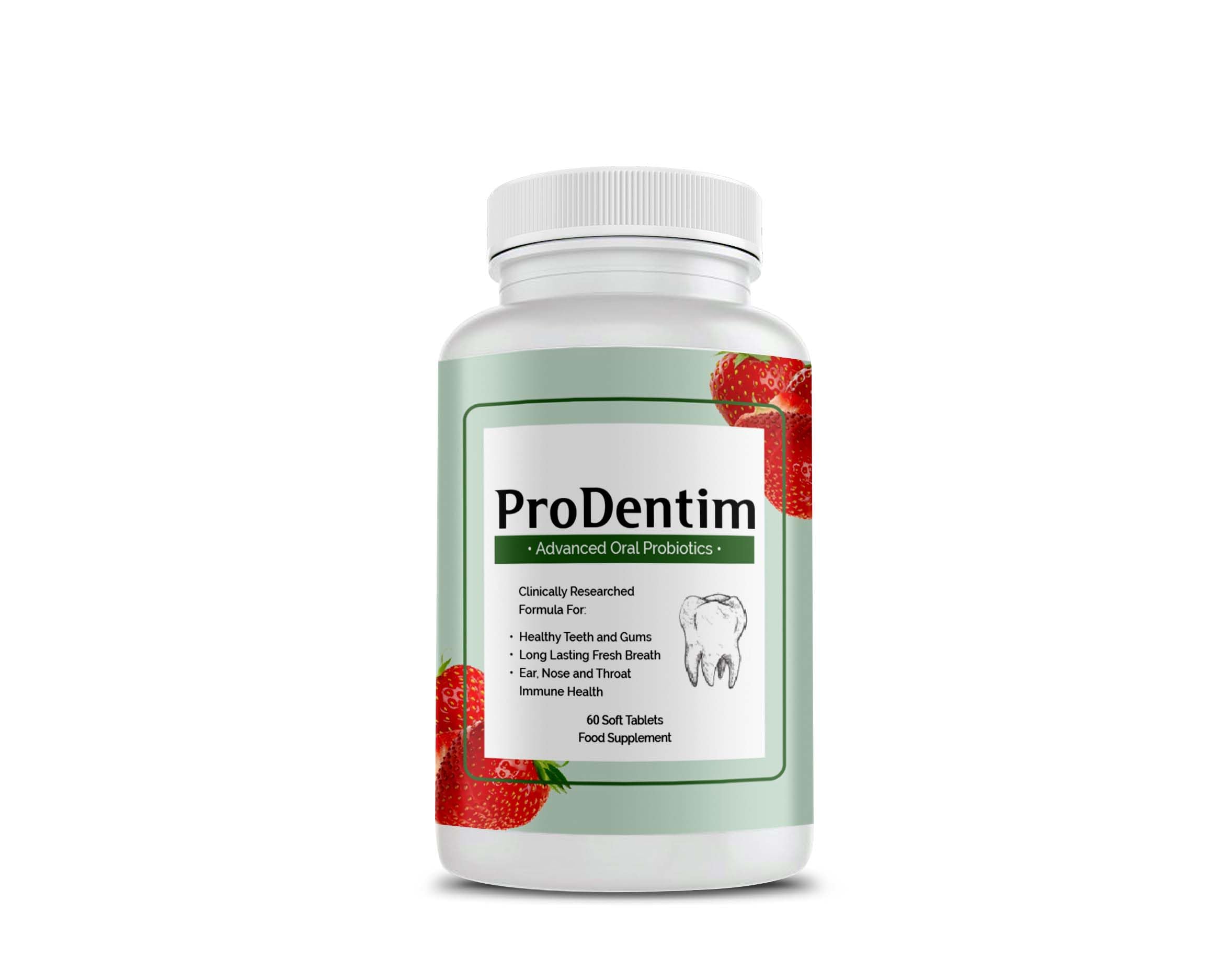
ProDentim is marketed as a chewable probiotic tablet for teeth, gums, oral bacterial balance, and fresh-breath support. The seller lists 3.5 billion total probiotics from L. paracasei, Bifidobacterium lactis BL-04, and L. reuteri, along with inulin, malic acid, tricalcium phosphate, and peppermint. The recommended use is to slowly chew one tablet each morning.
Best fit: a consumer comparing a chewable probiotic format who can confirm the current label, final checkout total, shipping, and refund conditions before ordering.
Skip or pause: anyone treating symptoms that may indicate dental disease, or anyone unable to confirm the exact amounts and seller terms relevant to their purchase.
- Potential advantages: a stated total probiotic count; named strains and additional ingredients; a chewable format; a 60-day money-back guarantee is advertised.
- Important limitations: exact strain quantities, tablet count, storage details, expiration information, and a complete Supplement Facts panel are not established from the available page; bundle totals are blank; shipping information is internally inconsistent, with free shipping stated while a two-bottle display includes a $9.99 shipping line; product-specific clinical evidence is not established.
DentaBiome and ProDentim: what can be compared?
| Feature | DentaBiome | ProDentim |
|---|---|---|
| Product type | Chewable dietary supplement marketed as an oral postbiotic | Chewable dietary supplement marketed as an oral probiotic |
| Named composition | L. plantarum, L. salivarius, L. rhamnosus complexes, xylitol, purple carrot powder, cranberry extract, and other listed components | L. paracasei, Bifidobacterium lactis BL-04, L. reuteri, inulin, malic acid, tricalcium phosphate, and peppermint |
| Stated use | One tablet daily; chew for about 30 seconds or allow to dissolve | Slowly chew one tablet each morning |
| Label clarity | Key amounts, bottle count, and tablet count are not clearly documented | Exact strain quantities, tablet count, and complete amounts are not established from the available page |
| Product-specific evidence | No independent clinical evidence specifically testing the finished product is identified | The cited strain research does not establish results for the finished product |
| Price and shipping | Final USD total is not reliably exposed; free U.S. shipping is advertised | Bundle totals are blank; free-shipping wording conflicts with a displayed $9.99 shipping line |
| Refund | 60-day money-back guarantee advertised; conditions are not fully explained | 60-day money-back guarantee advertised; return conditions should be confirmed |
This is not a clinical winner-takes-all comparison. DentaBiome has a more detailed list of seller-described formula categories, while ProDentim states a total probiotic count and named strains. Neither presentation supplies enough product-specific evidence or label detail to conclude that one will produce a particular oral-health outcome.
Who should consider an oral microbiome test or supplement?
A test may suit you if:
- You want descriptive information about a sample and understand that the result may not diagnose a condition.
- The provider explains its method, reporting scope, privacy practices, and professional interpretation options.
- You are prepared to discuss concerning results or symptoms with a dentist rather than self-treating.
A chewable supplement may suit you if:
- You want a convenient adjunct to, not a replacement for, brushing, interdental cleaning, examinations, and treatment.
- You can review the full label, ingredient amounts, warnings, and seller terms.
- You are comfortable with limited finished-product evidence and avoid disease-treatment expectations.
You should skip self-directed supplement use for a dental problem if:
- Your gums bleed or are swollen, or you have persistent bad breath.
- You have tooth pain, visible decay, loose teeth, facial swelling, or signs of infection.
- You are considering delaying professional care because a product claims to reverse decay or eliminate bacteria.
The American Dental Association advises people with swollen or bleeding gums to seek dental evaluation. A supplement should not be used to postpone that assessment.
What are the main limitations?
- General oral-probiotic research cannot be automatically transferred to DentaBiome or ProDentim.
- Claims about reversing decay, stopping bleeding gums, eliminating bacteria, whitening teeth, or producing rapid results should be treated as seller marketing unless directly supported by appropriate finished-product research.
- FDA-registered or inspected manufacturing language is not the same as FDA approval of a dietary supplement for safety or effectiveness.
- For both products, important label and commercial details require confirmation before payment.
- People who are pregnant, breastfeeding, taking medication, managing a medical condition, immunocompromised, or considering use for a child should obtain professional advice because suitability is not established here.
What is the practical next step?
If you are considering testing, first confirm what the report measures and how it will be interpreted. If you are considering a supplement, compare the complete current label and final checkout terms against your goal, while continuing standard dental care. For persistent or concerning symptoms, make the next action a dental appointment rather than a supplement order.
For readers who want a product-specific review, the existing Bestpricy coverage of DentaBiome safety and legitimacy and ProDentim safety and legitimacy provides a more focused look at seller wording and risk checks.
Related product options
Compare these researched options by label transparency, evidence, total cost and current terms before choosing.
Frequently asked questions
Is an oral microbiome test the same as an oral probiotic?
No. A test analyzes a collected sample, while a probiotic is a dietary product marketed to provide microorganisms. Neither replaces a dental examination.
Can an oral microbiome test diagnose cavities or gum disease?
Not by itself. Dental disease requires appropriate clinical evaluation; a microbial report should not be treated as a diagnosis.
Does DentaBiome reverse tooth decay?
That is a seller claim, not an independently established outcome for the finished product. Suspected decay requires dental care.
Does ProDentim have product-specific clinical proof?
The available material describes research on probiotic strains and the general category, but it does not establish a clinical trial of the finished ProDentim product.
Are oral probiotic supplements FDA approved?
Dietary supplements are not FDA-approved for safety or effectiveness before sale. Facility registration or inspection language does not mean the product itself is FDA approved.
What should I check before buying?
Check the full ingredient amounts, serving instructions, warnings, seller identity, final USD total, shipping, recurring-charge terms, and the exact refund procedure.
Sources reviewed
- DentaBiome official sales page
- ProDentim supplied seller text presentation
- Probiotics for managing caries and periodontitis: systematic review and meta-analysis
- Probiotics-containing beverages and dental caries: systematic review and meta-analysis
- Decreased gum bleeding and reduced gingivitis by Lactobacillus reuteri
- FDA: Is It Really FDA Approved?
- American Dental Association patient guidance
Bestpricy may earn a commission if you purchase through a product reference. This does not change our evidence-based discussion of claims, limitations, safety, or value.